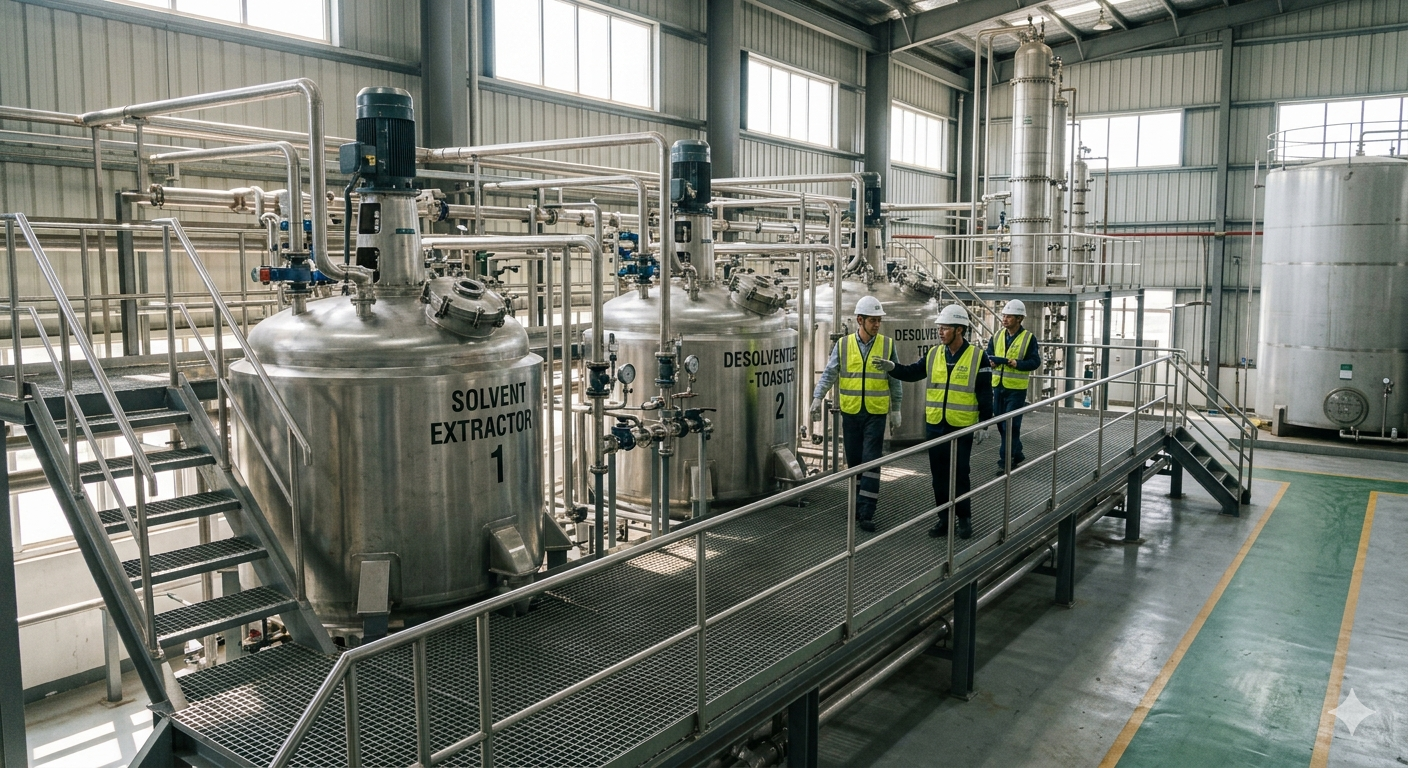
In the modern edible oil industry, efficiency and yield are critical for profitability. The solvent extraction process has become the preferred method for extracting oil from oilseeds due to its ability to recover almost all available oil.
Unlike traditional extraction methods, this process ensures minimal wastage and consistent output, making it ideal for large-scale operations.
What is the Solvent Extraction Process?
The solvent extraction process is a method of extracting oil using a chemical solvent, typically hexane. The solvent dissolves the oil content from oil-bearing materials, allowing for nearly complete recovery.
This process is widely used in industries dealing with soybean, sunflower, rice bran, and other oilseeds.
How the Solvent Extraction Process Works
1. Seed Preparation
Raw materials are cleaned to remove impurities such as dust, stones, and husks. This step ensures better efficiency in extraction.
2. Conditioning and Flaking
The seeds are heated and flattened into flakes. This increases the surface area, helping the solvent penetrate effectively.
3. Oil Extraction
The prepared flakes are passed through an extractor where the solvent dissolves the oil, forming a mixture known as miscella.
4. Oil and Solvent Separation
The miscella is heated to separate the oil from the solvent. The solvent is recovered and reused within the system.
5. Desolventizing
The leftover meal is treated to remove any remaining solvent, making it safe for further use, especially in animal feed.
6. Solvent Recovery
The solvent is condensed and recycled, ensuring cost efficiency and environmental safety.
Key Benefits of the Solvent Extraction Process
High oil recovery efficiency (up to 99%)
Reduced raw material wastage
Suitable for low oil-content seeds
Cost-effective for large-scale production
Consistent product quality
Applications in Industry
he solvent extraction process is used across multiple sectors:
Edible oil production
Animal feed manufacturing
Biofuel industries
Chemical processing
Its flexibility makes it an essential technology in modern processing plants.
Why Choose Solvent Extraction for Your Plant?
For businesses aiming to increase production efficiency and reduce losses, the solvent extraction process offers a reliable solution. It not only improves yield but also enhances overall plant performance.
Conclusion
The solvent extraction process plays a vital role in today’s edible oil industry. With its high efficiency, scalability, and cost-effectiveness, it has become the backbone of modern oil extraction plants.
Investing in this technology ensures better returns, improved quality, and long-term operational success.
What is the solvent extraction process?
It is a method of extracting oil using a solvent like hexane to achieve maximum oil recovery from seeds.
Which solvent is commonly used in the solvent extraction process?
Hexane is the most commonly used solvent due to its efficiency and ease of recovery.
What are the advantages of solvent extraction over mechanical pressing?
It provides higher oil yield, less wastage, and is more suitable for large-scale production.
Is the solvent extraction process safe?
Yes, when proper safety systems and protocols are followed, it is a safe and efficient process.